Neon Swarm 2.0: The Mainframe, Endless Mode and Game Center
Five more weeks on the tower defence game: a fourth world that doubles the campaign, a mode where the waves never stop, achievements and leaderboards, and a phone that folds in half.
Where it was, where it is
At the end of the last post, Neon Swarm had eighteen levels in three worlds and played start to finish, with real devices still to come. Since then it has been on an iPhone, an iPad and the iPhone Duo, it has a proper icon, and the campaign has grown to 30 levels in four worlds. Version 2.0 adds a whole second way to play.
World 4: the Mainframe
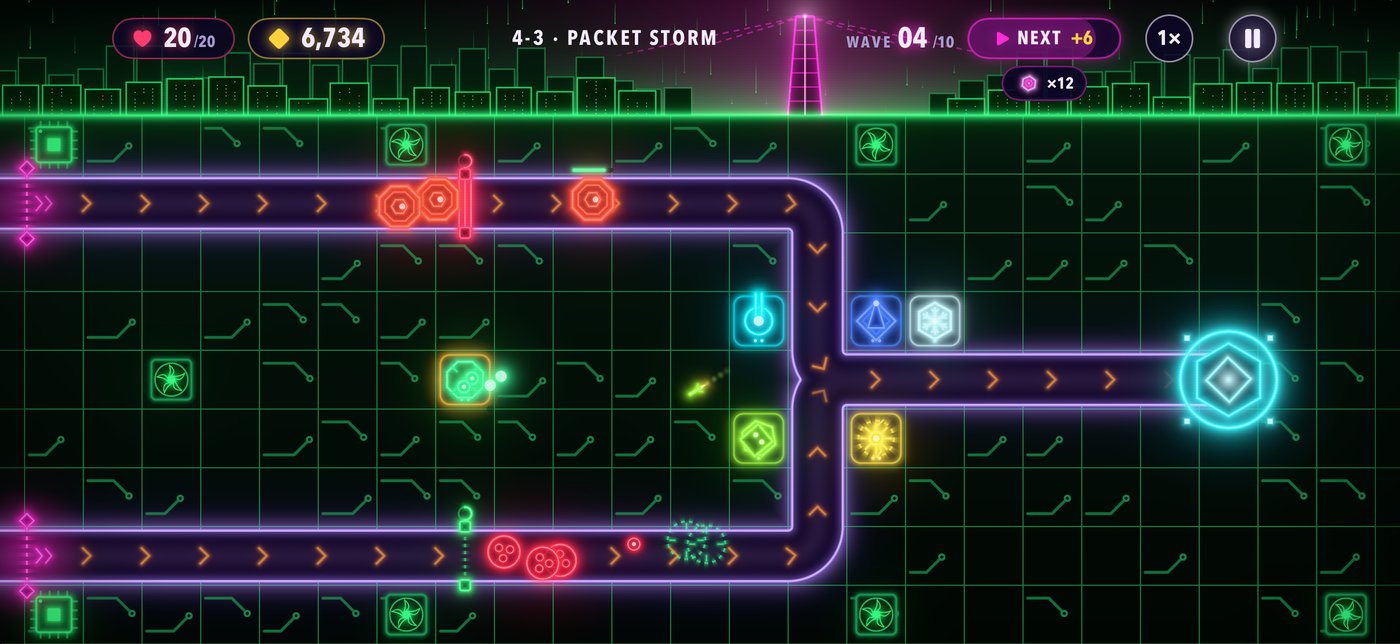
The first three worlds were sunsets, cities and beaches. The fourth goes inside the machine the swarm comes from: data rain falling over server racks, a tower on the horizon, and a circuit-board floor under an acid-green grid. It opens at 36★ and has twelve levels, twice a normal world, because it's the end of the campaign and the hardest stretch.

Every world has brought one new idea, and the Mainframe brings two.
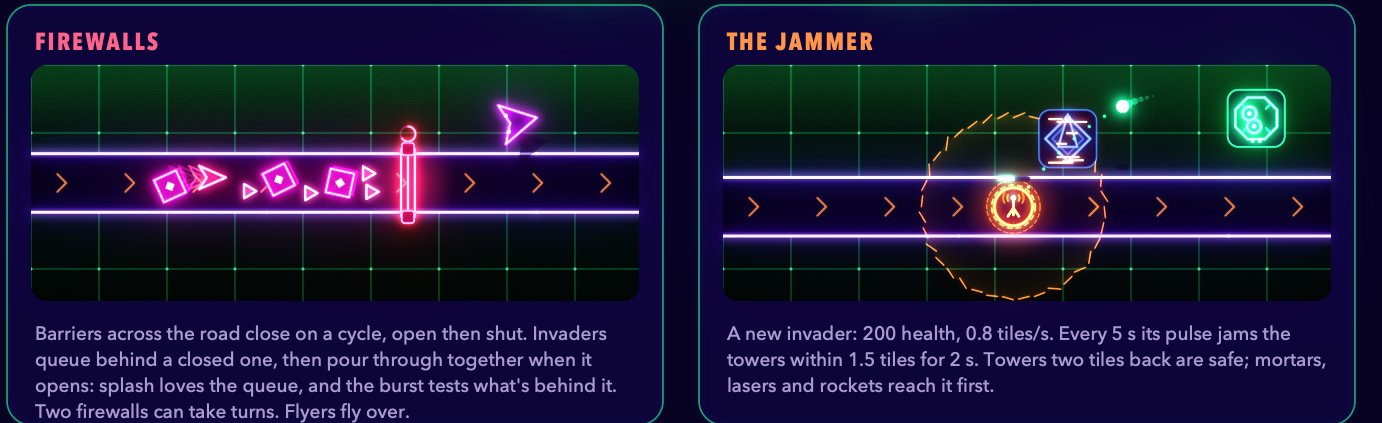
Firewalls are barriers across the road that close for a while, then open. While one is shut, invaders queue behind it, and when it opens they all pour through at once. That changes the rhythm of a level: a queue is a gift to splash damage, but the burst that follows is a test of whatever is waiting behind it. Levels with two firewalls set them to take turns.
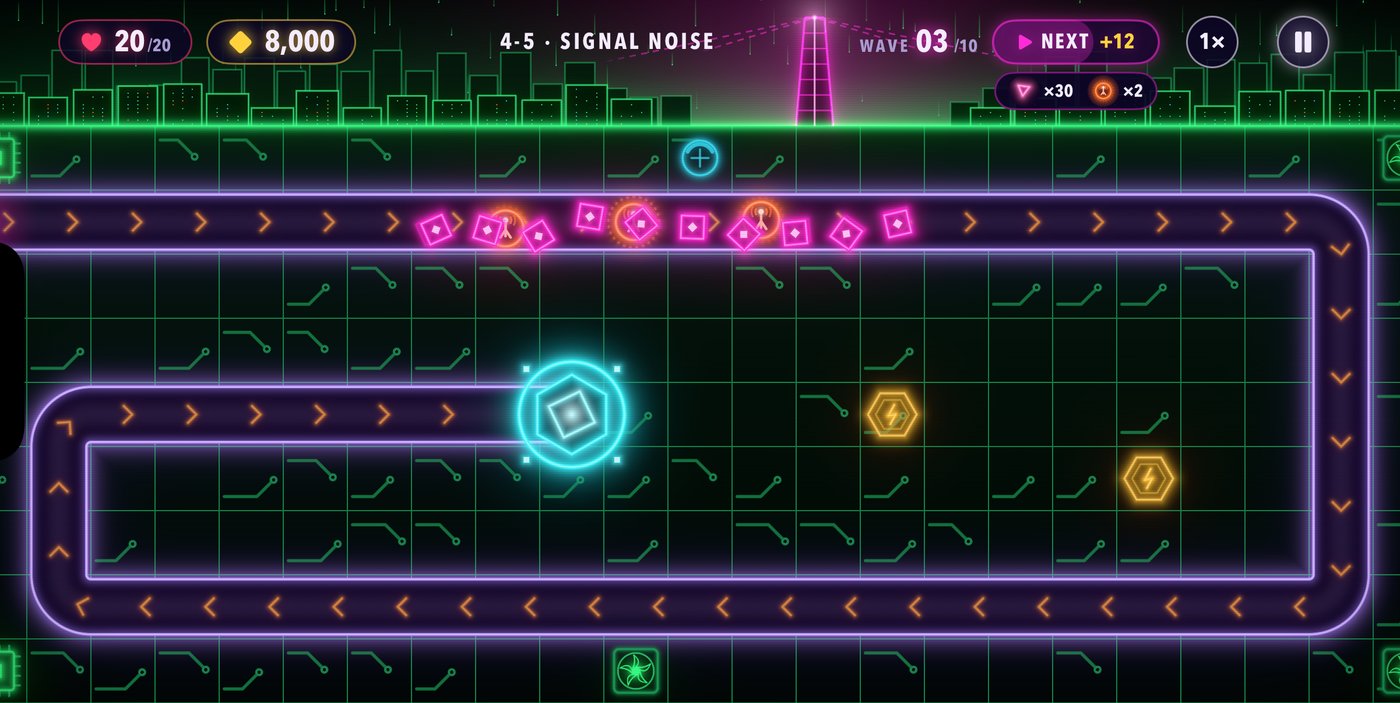
The Jammer is the tenth invader. Every few seconds it pulses, and any tower close to it stops firing for a moment. On its own that's a nuisance. In a queue behind a firewall, a few jammers keep pulsing while they wait, which silences the towers beside the queue right as it empties. The counter is distance: towers two tiles back from the road are never jammed, and anything with range can kill a jammer before it gets close.
I carried on naming the levels after things that go wrong with computers. Handshake, Overdrive, Packet Storm, Race Condition, Signal Noise, Crossfire, Deadlock, Buffer Overflow, Zero Day, Brute Force, Blue Screen and, as the finale, Root Access.
Endless mode
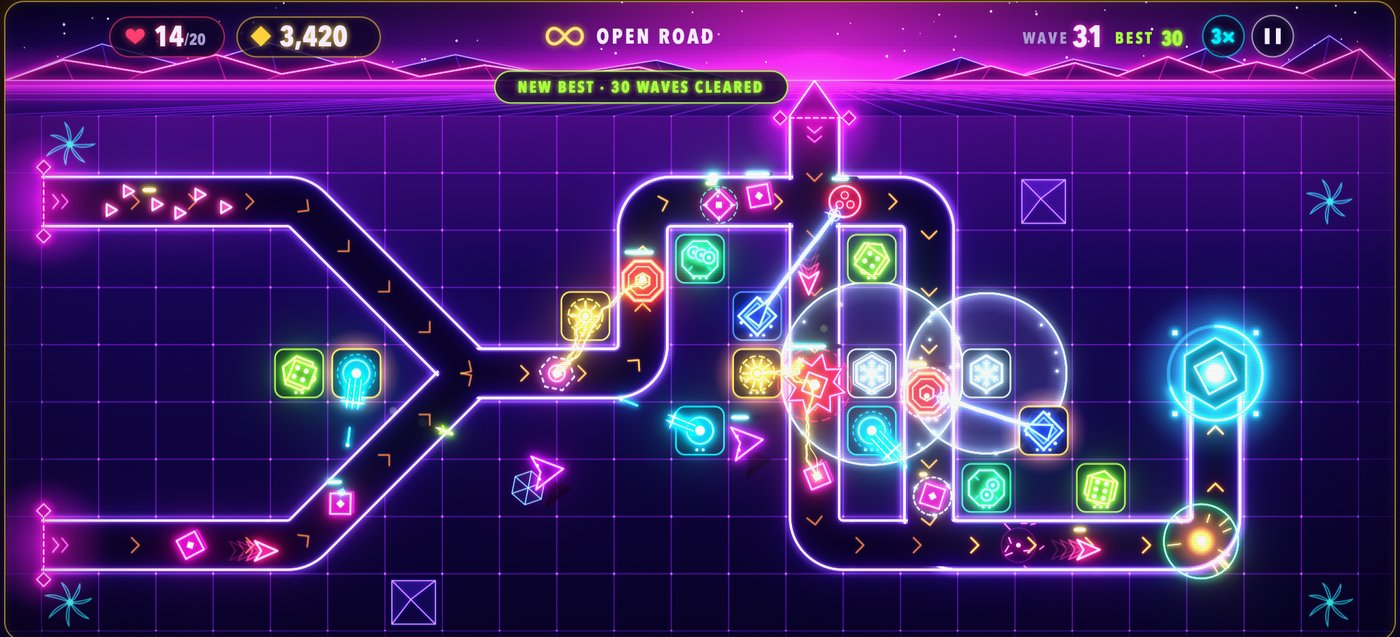
The campaign is built around short levels with an ending. Endless mode is the other thing people want from a tower defence game: how long can you last? Every world now has one endless map. The waves never stop, each is a little tougher than the last, and when the core finally falls, your score is the number of waves you cleared.
A few design decisions shaped it:
- New maps, not endless versions of old levels. The campaign maps are sized for eight to twelve waves. Each endless map has several gates, an air lane and a long shared run before the core, which is the kill zone a late run depends on. Four maps also means four leaderboards instead of thirty.
- The same waves for everyone. Each wave is generated from a recipe rather than written by hand, but the recipe is deterministic: wave 31 on Open Road is the same for every player on every run. That keeps the leaderboard fair, and it lets me plan a run and improve on it, which is most of the fun.
- Every run ends. Waves grow in two ways, more invaders and tougher ones. The count stops growing at a cap, so the frame rate is safe, but their health keeps compounding. There is only so much a board full of tier-three towers can do, so the core always falls eventually.
- No stars. Endless never counts towards unlocking a world, so the campaign's numbers stay exactly as they were.
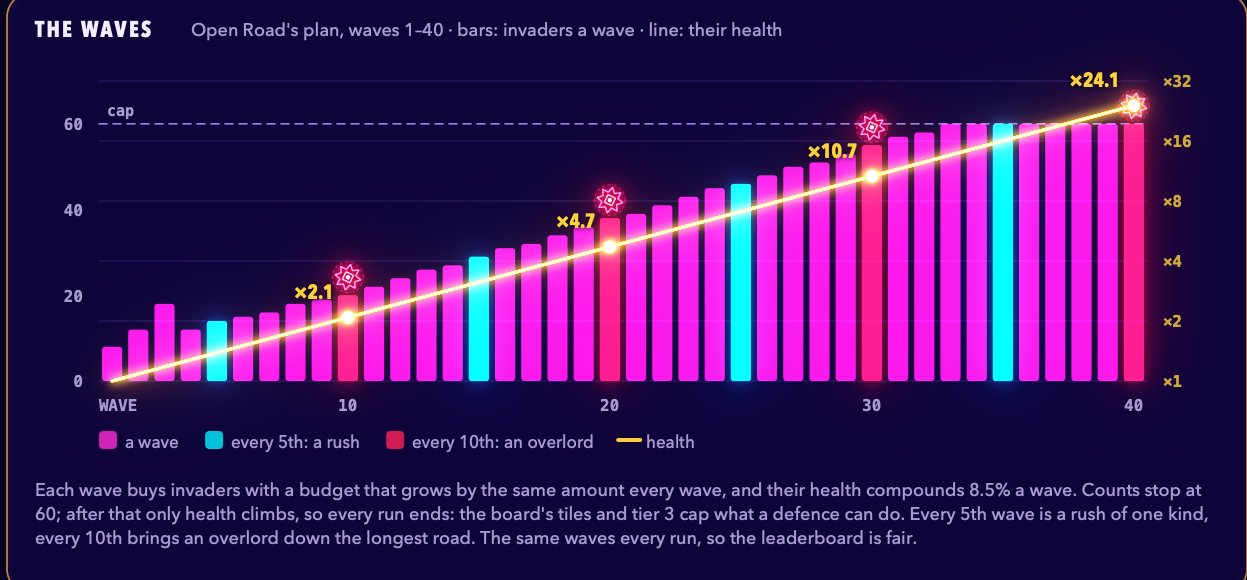

One feature took more care than the rest: a run survives the app being closed. iOS can quietly kill a suspended app, and a forty-wave run is too much to lose to a phone call. The game now records the run and saves it at the start of every wave, whenever you pause, and the moment the app leaves the foreground, which is the last point iOS promises before it may close it. Come back later and the run is waiting, paused, exactly where it was. It also meant the game now pauses itself whenever anything comes over it, in every level, which it should have done from the start.
Game Center
Leaderboards and achievements went in too: a score leaderboard for every level, one for each endless map, one for total stars, and 34 achievements. Some are milestones (clear a world, earn every star), some are challenges (beat a level with no upgrades, hold every life through the Mainframe), and a few are about how you play (shatter a shield, shoot down a flyer, stop a patcher).
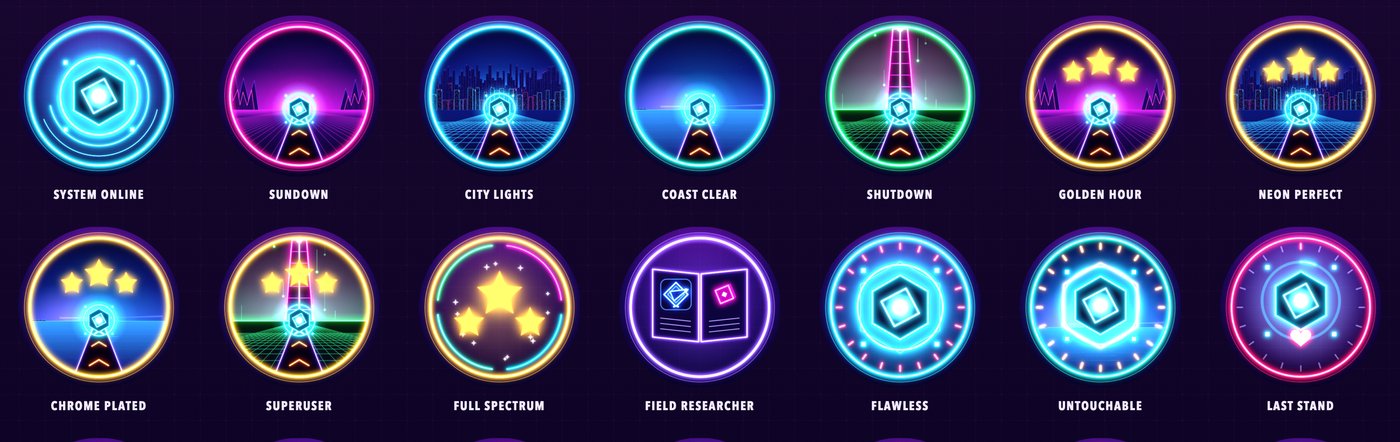
The badges follow the game's rule that nothing is hand-drawn. The same tool that renders the concept art draws every badge from the game's sprites, and because Game Center crops badges to a circle, each one keeps its subject inside the ring. The lesson from Nubrixy held: local progress is the source of truth, and Game Center is a mirror that gets re-synced, so nothing earned while offline is ever lost.
A phone that folds
The iPhone Duo arrived in the middle of all this, and it's a strange shape for a landscape game: a small outer screen, a big squarer inner one, and a camera sitting in one corner of the board. The game stays landscape on both screens, and because the board, the glow and the roads all follow the screen size every frame, opening or closing the phone mid-level just resizes the game and play carries on. On the outer screen the board lifts just clear of the camera into the spare sky, so no tile ever hides behind it.
Keeping it honest, still
The test count has doubled to 209. Every one of the 30 levels still has a reference build that must finish within a band of lives, and now each endless map has one too, which must clear a band of waves on every seed. The achievements are tested against Game Center's limits so I can't accidentally hand out more points than Apple allows. And the slowest test loads an endless run from wave 40 to make sure a long run still comes back after the app is closed.

What's next
The App Store listing is written, the screenshots and previews are made for iPhone, iPad and iPhone Duo, and 2.0.0 is built. What's left is the part I can't do from a keyboard: review, TestFlight, and finding out what strangers make of it. The next post should have a link.